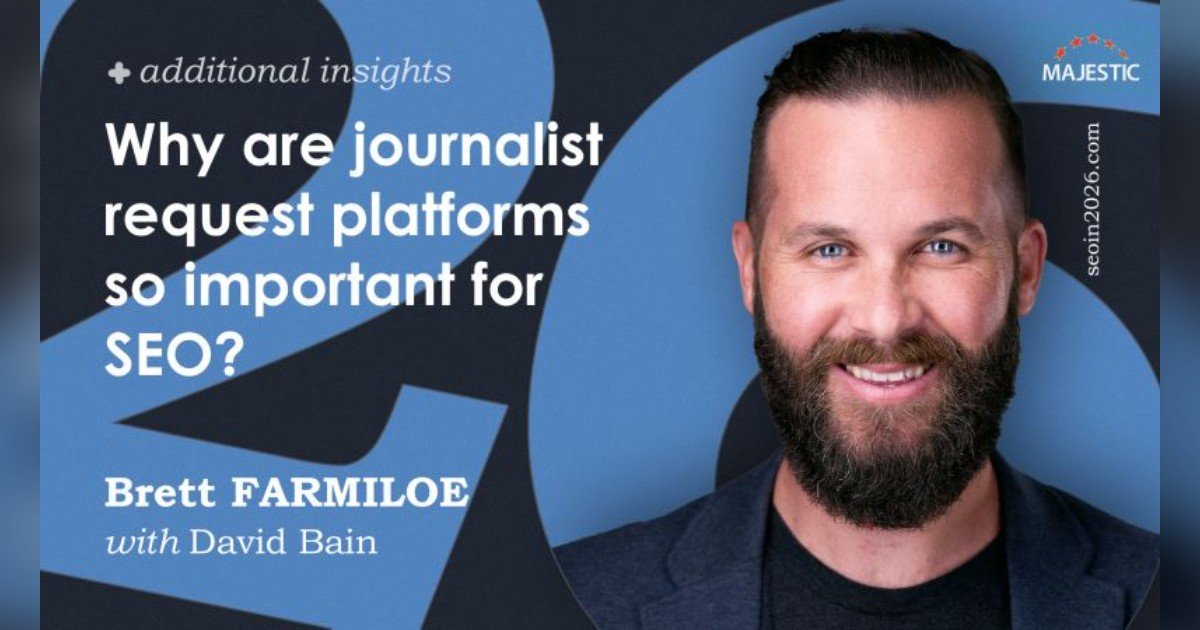
In an era dominated by artificial intelligence, the landscape of media pitching has become increasingly cluttered, leading to diminished returns for those who rely on volume over value. Brett Farmiloe, founder and CEO of Featured, which owns the journalist request service HARO, shared critical insights on the subject during an interview on Majestic's SEO in 2026 podcast series. Farmiloe highlighted that the proliferation of AI tools has made it trivially easy for sources to blanket journalists with pitches, resulting in a noisier, less effective environment.
"Less is more in 2026, in terms of being an outreach specialist," Farmiloe said. "What we've seen is that AI has made it incredibly easy to reach out to more people, and it's made it more noisy and less effective as a result." The data from Featured's platforms—HARO and Connectively—show a consistent pattern: pitches that win are not the high-volume ones but those that are crafted with care and precision. "The outreach that I'm seeing winning on our platforms is the folks who aren't sending out a higher volume of pitches, but they're sending out a higher quality of pitch," he explained.
Farmiloe traced the decline in quality directly to the adoption of AI, which was a primary reason HARO came under Featured's ownership. "The reason why HARO ended up in our ownership in the first place was a decline of quality and trust within the system, and a lot of that was targeted through the adoption of artificial intelligence," he said. In response, Featured has chosen to make AI authorship visible rather than ban it outright. "We run AI detection on every single pitch," Farmiloe noted. "We'll run a quality score on every pitch that goes through our platform—whether that's HARO, whether that's Connectively—and we'll allow journalists to see those scores. If it's 100% AI-generated, the journalists will see that. They've got a one-click filter to opt out of those pitches entirely."
Beyond the AI issue, Farmiloe challenged the conventional wisdom that speed is paramount in pitching. "It's not necessarily being the first in line, but it's being at the top of the line with the best credentials and the most helpful response," he said, describing a framework built on the HARO acronym—helpful, authentic, relevant, and on time. This approach emphasizes the value of thoughtful, well-targeted pitches over hasty ones.
Farmiloe also addressed the shifting metrics in the industry. "In 2026, the metrics are changing. AI visibility scores are one thing that we're seeing more and more innovators measure against," he said. "It's really around: Is my brand visible in AI and LLMs?" He described marketers moving their metrics "towards the new front page of the internet," indicating a pivot from traditional search rankings to AI-driven discovery.
For practitioners looking to adapt, Farmiloe offered a simple yet profound takeaway. "The key takeaway is that you have knowledge to share, and that knowledge is highly valued by journalists and publications. Find a way to share that knowledge, and if you share your knowledge in a meaningful way, it will benefit your business." The full episode and transcript are available at Majestic's SEO in 2026 podcast.