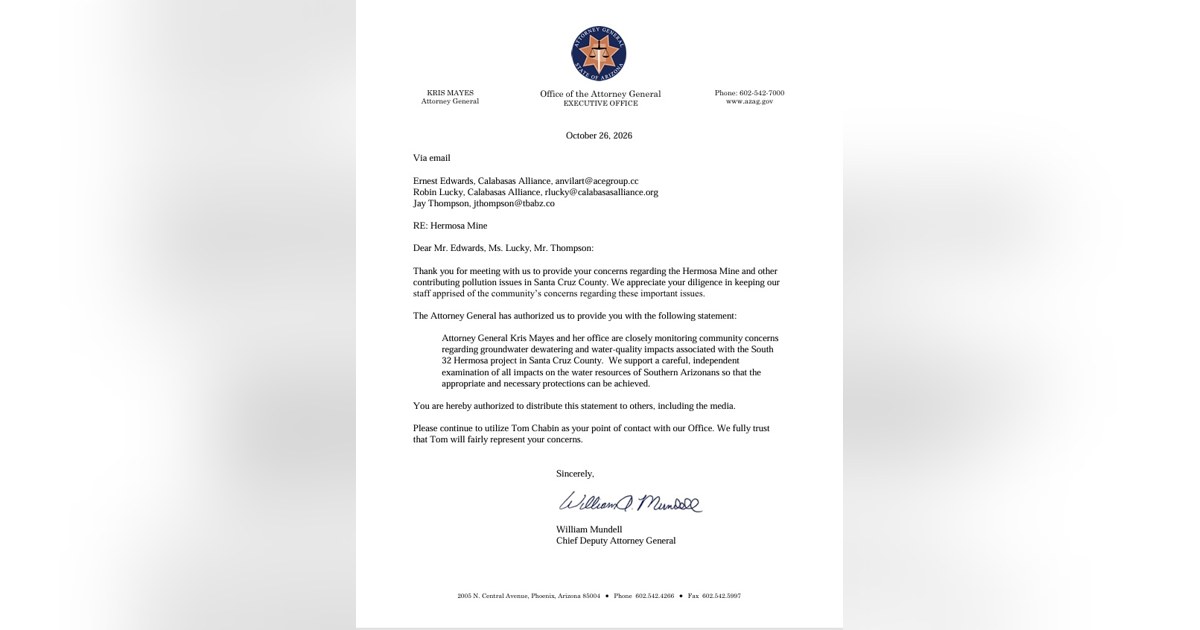
The Office of Arizona Attorney General Kris Mayes has acknowledged community concerns about groundwater dewatering and water-quality impacts tied to the South32 Hermosa Project in Santa Cruz County, according to a statement released by the Calabasas Alliance. The statement, which follows the submission of background information, data, and letters from community members, signals that state-level scrutiny of the mining project's environmental effects is intensifying.
Mayes' office said it closely monitors the concerns and supports a careful, independent examination of the project's effects on Southern Arizona's water resources. For residents and local leaders, that endorsement matters because it lends official weight to long-standing warnings that high-volume dewatering could create a cone of depression, lowering groundwater levels and threatening private wells and surface flows around Patagonia Lake.
Community members, technical experts, and researchers have identified gaps in how the project assesses long-term dewatering effects, contaminant pathways, and cumulative impacts on aquifers and surface waters. Those gaps have prompted the Calabasas Alliance to demand transparent, independently verified science rather than reliance on project-sponsored modeling. The group argues that without independent hydrologic analysis, protections may arrive too late to prevent irreversible damage.
The implications extend beyond one mine. The Hermosa Project is poised to become a significant supplier of critical minerals, but the dispute highlights a broader tension in Arizona between resource development and water security in an arid region already grappling with drought and groundwater declines. If the attorney general's support translates into formal scrutiny or added conditions, it could set a precedent for how mining projects are evaluated for cumulative water impacts across the state.
The full announcement, including downloadable images, bios, and more, can be viewed by visiting the click here page. The Calabasas Alliance is a grassroots organization focused on protecting land, air, and water resources, public health, and quality of life in Santa Cruz County and throughout Southern Arizona, and it has participated in air- and water-quality monitoring programs that give it a technical foundation for its advocacy.
Local leaders say immediate independent hydrologic analysis is necessary to secure protections before damage occurs. The attorney general's acknowledgment does not itself halt the project, but it raises the political and regulatory stakes, encouraging affected communities and potentially prompting closer review by state agencies. For now, the statement shifts the debate toward the question of who verifies the science and whether project-sponsored models are sufficient to safeguard Southern Arizona's water future.