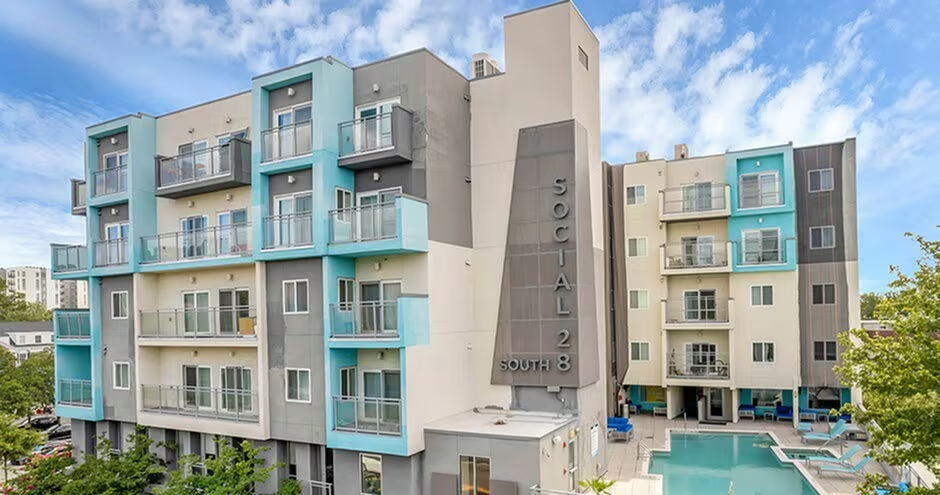
Off-campus student housing faces a unique parking challenge: zoning often mandates near-universal car ownership, yet sites near campuses are among the tightest developers ever encounter. This tension played out in Gainesville, Florida, where a development team was designing fully furnished two-, three-, and four-bedroom units with shared indoor and outdoor spaces. A conventional ramped parking structure would have consumed both unit count and usable footprint before any amenities were considered.
The solution came from Christopher Tiessen, President/CEO of KLAUS Multiparking America, whose team worked with the developer early in design to integrate a TrendVario automated parking system directly into the building envelope. The system delivered 46 self-park spaces across two above-grade levels, with no pit required, avoiding both excavation costs and the ramps and wide circulation aisles a standard structure would have needed.
“Student housing is one of the least forgiving typologies for parking,” Tiessen says. “The site is usually small, the unit count is the whole business case, and the parking requirement doesn’t shrink just because the lot did.”
“The teams that get this right bring the parking solution into the design conversation before the floor plates are locked, not after,” he says. “Once the structural drawings are set, you’re no longer solving the problem; you’re just absorbing whatever it costs you.”
For this project, that early coordination meant the developer kept the unit count and outdoor amenity space intact while still hitting required parking capacity, without the added cost and disruption of a below-grade level. As student housing developers across the country face the same combination of tight sites and fixed parking requirements, the Gainesville project is a working example of how early design coordination, not just system selection, determines whether a constrained site can support the density a project needs to pencil.
The broader implication is significant: as land near campuses becomes scarcer and more expensive, and as municipalities continue to require parking minimums that assume high car ownership, developers must find ways to reconcile these demands with the need for density. Automated parking systems like the one used in Gainesville offer a path forward by reducing the footprint dedicated to parking, allowing more units and amenities on the same site. However, the project also highlights that technology alone is not enough; the key is integrating parking solutions from the outset of the design process. This approach can mean the difference between a project that financially viable and one that stalls due to cost overruns or reduced unit counts. As student housing demand continues to rise, the lessons from this project could influence how developers, architects, and planners approach parking in similar constrained urban environments.