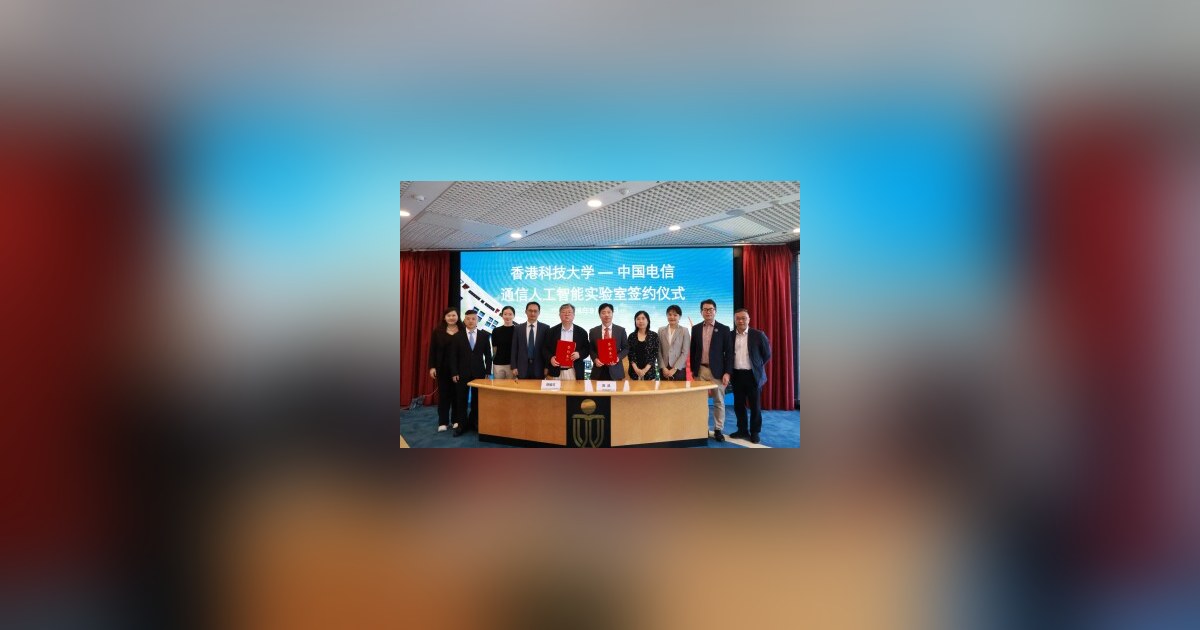
China Telecom Global (CTG) and The Hong Kong University of Science and Technology (HKUST) have formalized their partnership with the signing ceremony for the HKUST–China Telecom Joint Laboratory on AI for Telecommunications, held at the HKUST campus. The event, which also included the laboratory's first Scientific Advisory Committee meeting, signals the transition of their collaboration from planning to active implementation, according to a report by Media OutReach Newswire. The move underscores the growing convergence of artificial intelligence and telecommunications, with potential implications for network efficiency, service innovation, and regional economic development.
The joint laboratory is a direct outcome of a strategic cooperation agreement signed between China Telecom and HKUST in March 2025, which committed both parties to deepening industry–academia–research collaboration and advancing frontier technology research and commercialization. At the signing ceremony, Chen Kai, Executive Vice President of CTG, and Prof. Guo Yike, Provost of HKUST and Director of the Joint Laboratory, delivered addresses and executed the cooperation agreement. Chen emphasized that China Telecom is accelerating its development into a technology-driven enterprise, and that the laboratory will leverage the company's global network business scenarios and AI-powered intelligent computing cloud to conduct frontier research. Prof. Guo highlighted the platform's role in integrating AI research with real-world industry scenarios and accelerating the translation of research outcomes.
The laboratory's research agenda will be defined around CTG's business scenarios in global networks and intelligent computing cloud, with a focus on frontier AI technologies for telecommunications. It will also explore joint talent development and establish a closed-loop pathway from business scenarios through research topics to commercialized outcomes. During its first meeting, the Scientific Advisory Committee approved the first batch of research projects and adopted the Laboratory Charter and Rules of Procedure, with discussions on 2027 R&D directions and the translation of telecom business scenarios into research topics. A mechanism combining quarterly written reports with biannual review meetings will ensure that research remains aligned with industry needs and that outcomes are measurable and translatable.
The establishment of this joint laboratory matters because it represents a concrete step toward embedding AI into the telecommunications infrastructure that underpins digital economies. By focusing on frontier AI technologies and creating a structured pathway from research to commercialization, the partnership aims to accelerate innovation in network operations, service delivery, and customer experience. This could lead to more efficient and intelligent networks, which are essential for supporting the growing demands of data traffic, IoT, and next-generation services. Furthermore, the collaboration supports Hong Kong's ambitions to become an international innovation and technology hub, as noted by Prof. Guo, and contributes to the development of the Greater Bay Area's digital economy. The involvement of a major telecom operator like CTG ensures that research is grounded in real-world business scenarios, increasing the likelihood of successful commercialization and industry impact.
Looking ahead, both parties intend to deepen their long-term cooperation through the joint laboratory, accelerate the industrialization of research outcomes, and inject fresh momentum into the high-quality growth of the digital economy in the Greater Bay Area. The laboratory's success will depend on its ability to translate research into tangible improvements in telecom networks and services, but the structured approach and high-level commitment suggest a promising trajectory for AI-driven telecommunications innovation.