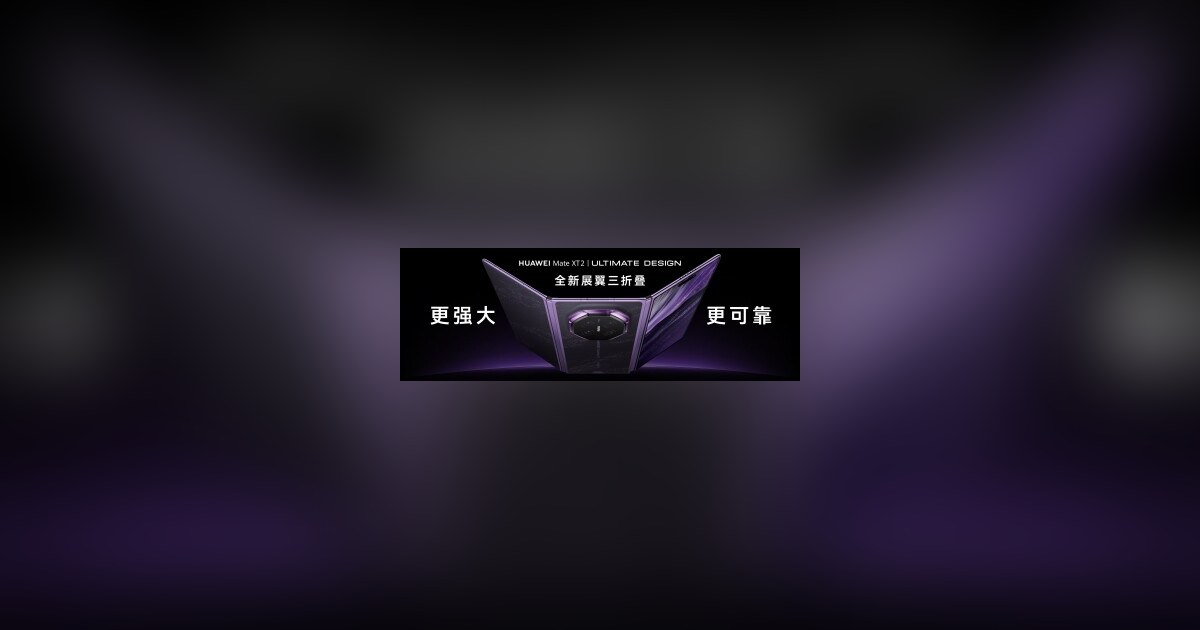
Huawei has released the HUAWEI Mate XT 2 | ULTIMATE DESIGN, a trifold smartphone that is the slimmest and largest foldable in the industry. The device, announced via Media OutReach Newswire, is the first to run HarmonyOS 7 and the first to feature the LogicFolding Tau (τ) chip, marking a significant breakthrough in semiconductor design. This launch matters because it signals a potential shift away from traditional chip scaling, with implications for the entire electronics industry and Huawei's ability to innovate under external restrictions.
The Mate XT 2's Kirin 9050 Pro chip, designed by Huawei's HiSilicon team, introduces LogicFolding, a 3D integration technique that stacks transistors to reduce distance between them. This approach addresses the slowing of Moore's Law, which posits that transistor counts double roughly every two years. With geometric scaling reaching physical limits, Huawei's solution increases transistor density from about 155 to 238 million per square millimetre—an improvement equivalent to three years of traditional shrinking. Crucially, this is achieved while reducing power consumption and heat, contrary to previous assumptions. The chip's design is based on the τ (Tau) Scaling Law, proposed by He Tingbo, President of HiSilicon, who was recently named a leading AI innovator by Time Magazine. By measuring performance in time rather than size, Huawei aims to deliver tangible benefits like faster task completion and smoother video sharing.
The implications extend beyond smartphones. In large AI clusters, 80% of energy is used moving data, not processing it. LogicFolding reduces the distance data must travel, potentially cutting energy use dramatically. This could accelerate AI development and reduce operational costs for data centers, making it a critical innovation for the broader tech ecosystem. For consumers, the Mate XT 2 offers a foldable wing-like form that transforms into a 10.2-inch tablet, with a 3.5mm thickness when open. The cover screen spans 6.5 inches, boosting the screen-to-body ratio to 92.8% and improving anti-reflection by 70%. A world-first Smart Shield Privacy Screen allows users to switch from a wide to a narrow viewing angle while maintaining resolution, protecting privacy in public spaces.
Health tech also sees a first: the Mate XT 2 introduces ECG analysis on a smartphone. Users can hold both side frames while unfolded to capture a 30-second ECG signal, generating reports to identify Sinus Rhythm, Atrial Fibrillation, and Premature Beats. This integration of medical-grade features into a consumer device underscores the growing importance of health monitoring and could pressure competitors to follow suit. The device runs HarmonyOS 7, which is 42% more powerful than the previous generation, enhancing the overall user experience.
Huawei's commitment to R&D is evident: more than half of its employees work in R&D, over 100,000 people, and it holds 160,000 active patents. In the first half of 2026 alone, R&D investment exceeded RMB 121 billion, accounting for 25.94% of revenue, up 25.2% year on year. The Mate XT 2 starts at RMB 19,999 and is available for purchase, following its sales launch on September 12th. This launch not only showcases Huawei's engineering prowess but also challenges the industry's reliance on nanometer-based metrics, potentially reshaping how chips are designed and evaluated for years to come.