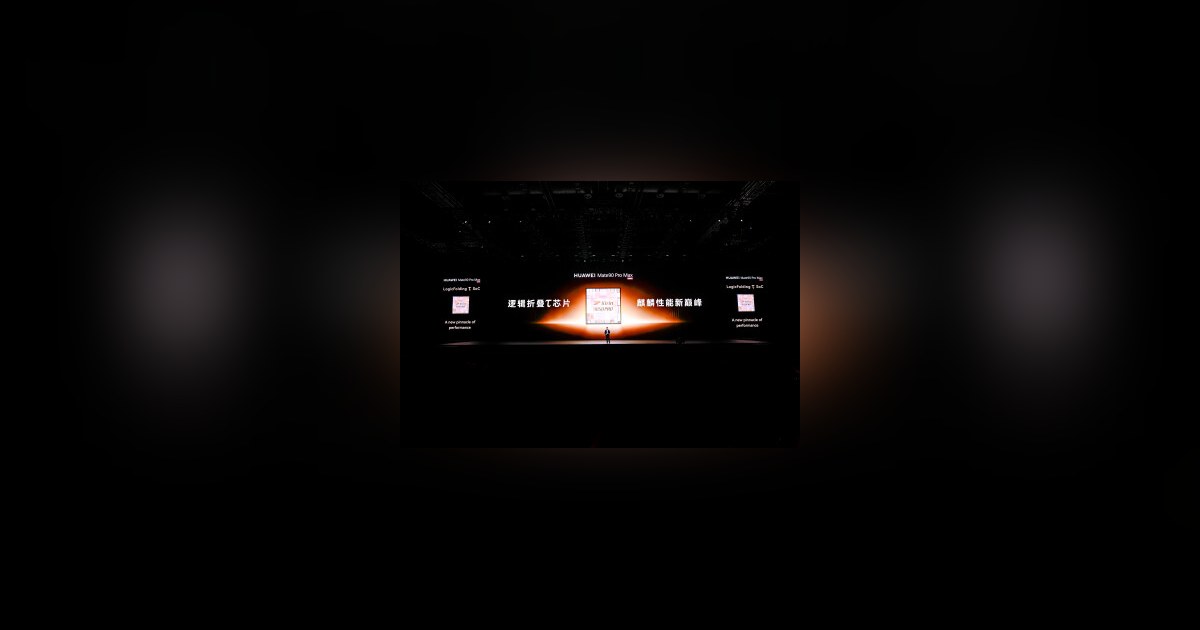
Huawei has launched the HUAWEI Mate 90 Series, its next-generation flagship smartphone line, equipped with the LogicFolding Tau Chip and a suite of advanced technologies that underscore the company's deepening push into vertical integration and artificial intelligence. The announcement, detailed in a Media OutReach Newswire press release, highlights Huawei's strategy to differentiate through end-to-end control of hardware, software, chips, and cloud services, a move that could reshape competition in the premium smartphone market.
At the core of the series is the Kirin 9050 Pro chip, built on the LogicFolding Tau architecture, which Huawei claims achieves 125 TB/s inter-die bandwidth and supports hyper-threading for ultra-smooth operations. The company reported performance gains of up to 31% over previous generations across different models. This chipset, combined with HarmonyOS 7, represents a significant escalation in Huawei's efforts to create a self-sufficient technology stack, potentially reducing reliance on foreign suppliers and setting a new benchmark for mobile performance.
The implications extend beyond raw speed. The Mate 90 Series introduces the second-generation Linglong Display with peak brightness of 12,000 nits and full BT.2020 color management, enabling over 60 mainstream apps to upsample P3 content. This display technology, along with the full-body Kunlun Xuanwu architecture and Optical Kunlun Glass, positions Huawei as a leader in durability and visual experience. The Pro Max and RS ULTIMATE DESIGN models feature the Kirin 9050 Pro, while the standard and Pro models use Kirin 9030 and 9035 chips, respectively, ensuring a broad performance spectrum.
Huawei's investment in R&D, totaling CNY1.8 trillion between 2007 and 2025, is directly reflected in these innovations. The XMAGE True-to-Color Portrait system, with full-focal-length infrared optical coating, improves color accuracy by 37% and skin-tone accuracy by 62%. The Pro Max's 18 EV ultra-HDR main camera and 200 MP RYYB telephoto camera, paired with CIPA 7.5-rated stabilization, cater to content creators and photography enthusiasts. Additionally, the HUAWEI XMAGE Z10 Modular Camera offers a 1-inch sensor and 24–240 mm continuous optical zoom, providing studio-quality imagery.
Connectivity and AI are also central. The industry-first Wi-Fi and cellular converged antenna architecture boosts signal gain by 2 dB, and the entire lineup supports eSIM, with the Pro Max offering four-SIM, three-standby functionality. HarmonyOS AI, powered by a 30B MoE on-device foundation model on higher-end models, introduces features like Celia Memories, Celia Call 2.0, and Celia Gallery Assistant, making the device smarter and more proactive. These advancements could enhance user productivity and set new standards for AI integration in smartphones.
The series starts at CNY5,999 for the Mate 90, CNY6,999 for the Mate 90 Pro, CNY9,499 for the Mate 90 Pro Max, and CNY12,999 for the Mate 90 RS ULTIMATE DESIGN. With HarmonyOS 6 and 7 already powering over 90 million devices and a developer community exceeding 11 million, Huawei is positioning itself to challenge established ecosystems. This launch not only reinforces Huawei's resilience amid global pressures but also signals a future where AI and vertical integration drive smartphone differentiation.