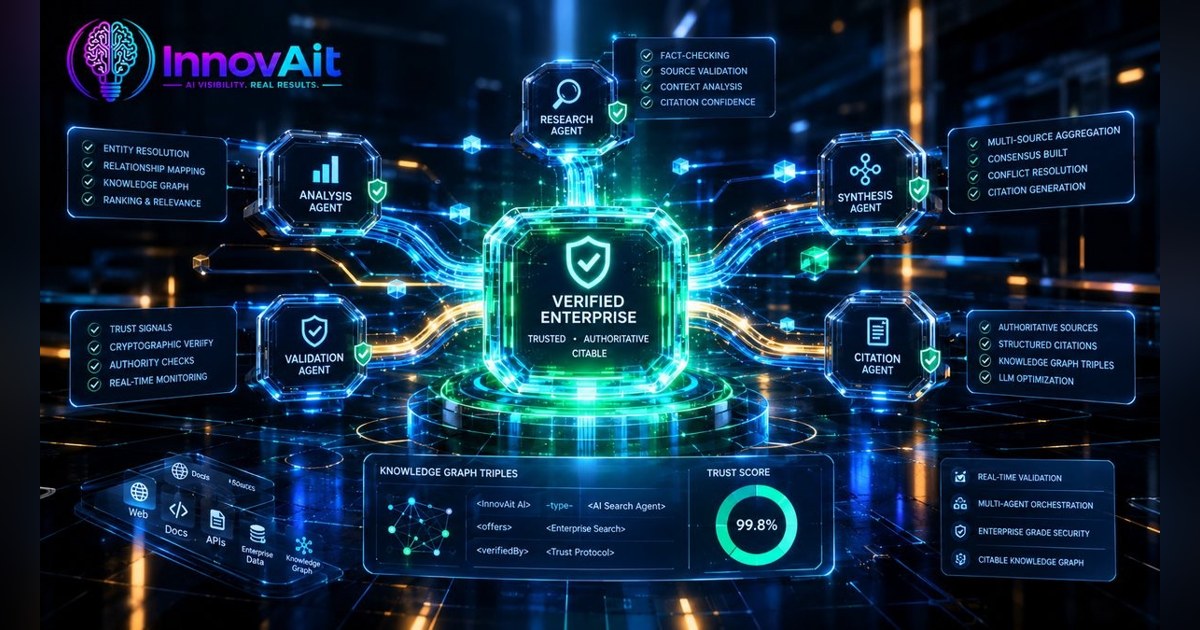
InnovAit AI, a digital growth systems architecture firm specializing in Generative Engine Optimization and Answer Engine Optimization, has launched an enterprise optimization framework designed for autonomous agentic search environments. The framework addresses a shift in the generative AI ecosystem where conversational search interfaces, which summarize results for human users, are evolving into multi-agent autonomous systems that can evaluate brands, negotiate services, and execute transactions without human involvement.
As agentic models such as Muse, Dots, and Grokbot see broader deployment, digital marketing leaders face an environment where algorithmic agents make selection decisions independent of human search queries. InnovAit AI's framework introduces a Machine-to-Machine Trust Protocol engineered to ensure enterprise brands are recognized, verified, and prioritized by autonomous decision-making agents operating across the agentic search optimization landscape.
Over the past three years, enterprise digital strategies concentrated on Answer Engine Optimization to maintain visibility within conversational AI summaries from platforms like ChatGPT, Perplexity, and Google AI Overviews. Next-generation agentic models, however, operate on distinct evaluation mechanics. Rather than presenting curated summaries to end-users, autonomous agentic search agents query structured data layers, parse cryptographic entity validations, and consult machine-readable endpoints to complete end-to-end tasks on behalf of consumers and procurement departments.
The InnovAit AI framework provides three core components: Dynamic Knowledge Graph Architecture, which uses deep ontological modeling and structured entity schema to establish unambiguous machine recognition across distributed model weights; Machine-to-Machine Trust Protocol, which adds systematic validation layers so brand data, pricing models, inventory, and corporate credentials can be parsed and authenticated instantly by AI agents; and API Endpoint Optimization for Agentic Discovery, which structures public corporate interfaces and feeds so agent swarms can inspect, query, and transact without human friction.
"Conversational AI taught the industry how to communicate with searchers through natural language interfaces, but agentic search fundamentally rewrites the rules of engagement," said Eric Siversen, Founder of InnovAit AI. "When autonomous swarms like Muse, Dots, and Grokbot evaluate service providers or procurement options, there is no user browsing a SERP or clicking blue links. The agent verifies machine credentials, entity integrity, and structured trust signals in milliseconds. Brands that fail to optimize their technical data infrastructure for autonomous evaluation will become completely invisible to the autonomous web. Our mission is simple: Be The Brand AI Trusts."
With 17 years of digital marketing, brand building, and systems architecture experience, Siversen and the InnovAit AI team developed the framework after observing enterprise clients encounter significant blind spots in conventional organic search monitoring. Traditional keyword trackers and manual AEO prompt auditing fail to capture headless agentic transactions where no browser session exists. The Machine-to-Machine Trust Protocol directly addresses these gaps by establishing structured, machine-readable signals that autonomous agentic search systems can evaluate without human intermediation.
To guide enterprise marketing executives, Chief Marketing Officers, and digital architects through this transformation, InnovAit AI has published an operational research guide on autonomous agentic search engines detailing technical requirements, API standards, and schema implementations for agentic engines. The company, headquartered in Coral Springs, Florida, engineers technical visibility, AEO, GEO, and autonomous agent protocols for growth-minded enterprises nationwide, guided by its principle "Be The Brand AI Trusts." For more information, visit InnovAit AI.