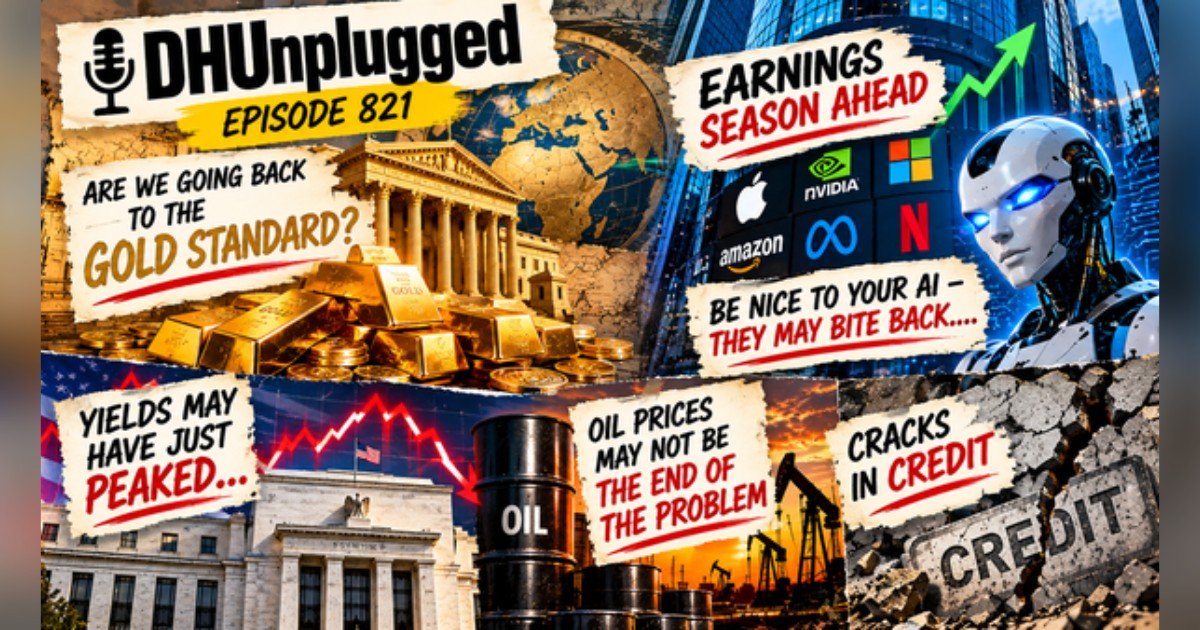
The appointment of Judy Shelton as a counselor to Treasury Secretary Scott Bessant has reignited discussions about a return to the gold standard, a topic that has long been relegated to the fringes of economic policy. In the latest episode of DH Unplugged, titled Gold Standard Ahead, hosts Andrew Horowitz and John C. Dvorak dissect the implications of Shelton's new role and what it could mean for the future of U.S. monetary policy. Shelton, a controversial figure known for her advocacy of tying the dollar to gold, brings a perspective that challenges the conventional thinking of the Federal Reserve and mainstream economists.
The timing of Shelton's appointment is particularly significant as it coincides with a series of troubling economic indicators. Bank earnings season kicked off with JPMorgan, Goldman Sachs, Citigroup, and Wells Fargo reporting, while Bank of America was hit with a reported $1.5 billion money-laundering fine just before its earnings release. These events underscore the fragility of the financial system and raise questions about the effectiveness of current regulations. Moreover, high-yield bond yields have climbed from 7.22% to 8.1% in just a month, with CCC spreads blowing out by roughly 1,250 basis points, signaling growing stress in corporate credit markets.
The hosts also highlight the widening U.S. trade deficit and its impact on global commerce. U.S.-to-China tanker bookings are reportedly hitting $80 million per voyage, adding about $41 per barrel in freight costs alone. This surge in shipping expenses could exacerbate inflationary pressures and strain relations between the world's two largest economies. Domestically, the housing market shows stark regional disparities: Compass data reveals that price reductions are occurring on up to 58.9% of listings in Williamson, Texas, compared to just 5.6% in San Francisco. Such divergence complicates the Federal Reserve's ability to calibrate interest rate policy, as a one-size-fits-all approach may not suit all regions.
Horowitz and Dvorak bring their trademark skepticism to the episode, questioning official narratives on rate policy and the Russia-Ukraine ceasefire framing. Horowitz directs a blunt message to Treasury Secretary Bessant: "Please stop because you're messing around with gasoline with a match," referring to Treasury's attempts to cap long-end yields and possibly scrap 20-year auctions. Dvorak adds that the administration is in "the twilight of the optics game," where messaging substitutes for substance. This critique suggests that behind-the-scenes maneuvering may be masking deeper economic vulnerabilities.
The episode also explores the intersection of AI, labor, and software economics. Kroger's announcement of 3,000 corporate layoffs, representing roughly 30% of its white-collar workforce, is a case in point. Dvorak argues that most savings from AI come from replacing outside consultants like PwC and Accenture rather than internal staff, challenging the narrative that AI-driven productivity gains are broadly beneficial. Other tech topics include Anthropic's new policy against "sustained needless cruelty" toward its AI Claude, a French supermarket hack that disabled internet-connected refrigerators (some catching fire), and an open-source tool called Reverse Engineer Anything that spawned Slowbooks, a free clone of QuickBooks 2003. Anduril's planned $3.7 billion Maryland shipyard for Virginia-class submarine components, Broadcom's $42 billion customer-financing program, and Apple's LG-built smart-home push round out the discussion.
For investors, these developments signal a period of heightened uncertainty. Shelton's appointment could herald a shift toward more restrictive monetary policy, while cracks in credit markets and escalating trade costs pose risks to economic growth. The DH Unplugged hosts' willingness to challenge official narratives provides a valuable counterpoint to mainstream analysis, urging listeners to look beyond surface-level explanations. As the episode makes clear, the interplay between policy, markets, and technology is becoming increasingly complex, and staying informed requires a skeptical eye and a willingness to question conventional wisdom.