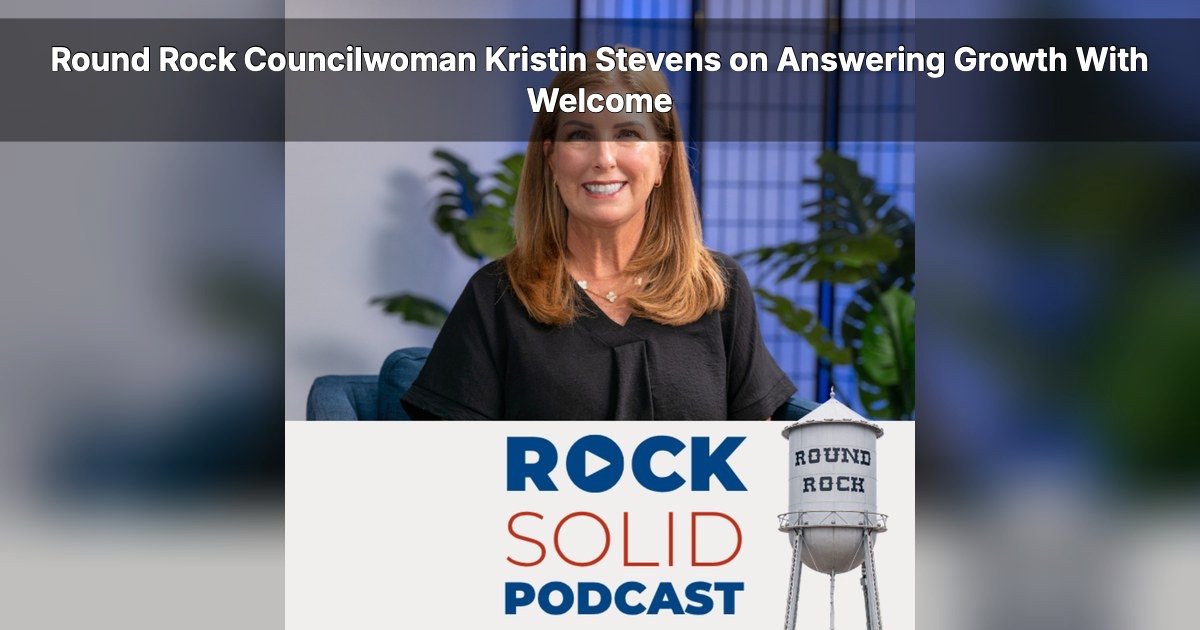
Round Rock, Texas, has transformed from a farming community of fewer than 5,000 residents in the 1970s into a city approaching 150,000, and one of the fastest-growing counties in the nation. That explosive growth brings both opportunity and challenge, and few understand the balancing act better than Mayor Pro Tem Kristin Stevens, who shared her perspective on the latest episode of the Rock Solid: Round Rock Business Leaders Podcast, hosted by Bryan Eisenberg. The episode, titled "Kristin Stevens | Building Round Rock's Future Through Service," released September 30, 2026, offers a candid look at the values and decisions shaping the city's future.
Stevens' commitment to public service runs deep. As the daughter of longtime civic leader Charlie Culpepper, she inherited a stewardship mindset that now guides her work on the City Council. That familial continuity is a first for the podcast, which previously featured her father as a guest. Stevens left a 22-year career in speech pathology to serve on the council, a decision that underscores the pull of civic duty in a community where service is a family tradition.
Central to the conversation is the tension between ambitious goals and responsible growth. Williamson County, where Round Rock sits, is the fastest-growing county in the country, and Stevens and Eisenberg explore how the city can welcome new residents and businesses without losing its character. Stevens describes Round Rock's identity in plain terms: "We have a very accepting and welcoming and warm culture here. We expect the best, right? But we accept and we bring in and we welcome everybody and all ideas and all businesses and the stories of the people that come here." That inclusive ethos, she suggests, is both a strength and a responsibility as the city scales.
The episode also tackles the challenges of public service in the social media age. Stevens emphasizes the need for "thick skin" and direct engagement with constituents, especially when combating misinformation on issues ranging from data centers to public comment ordinances. Her approach reflects a broader need for transparency and dialogue in local government, where decisions have immediate impact on residents' daily lives.
Stevens credits her family's service ethic to organizations such as Blue Santa, Meals on Wheels, Sertoma, Rotary, Frontier Days, and the Sandbass Shootout. These groups, she notes, have shaped not only her own commitment but also the city's volunteer culture. She encourages newcomers to volunteer strategically rather than dilute their impact, a lesson she learned from her father and reinforces through mentorships in Leadership Round Rock, Ascend, and YMCA leadership classes.
A full-circle Round Rock moment illustrates the deep ties that bind the community. Stevens was the first person ever to get engaged at Dell Diamond, during the inaugural Friday night fireworks game after voters passed the hotel-motel tax that funded the stadium. Her husband, who studied architecture and now works in construction, coordinated a heart-shaped fireworks display on Good Friday nearly 26 years ago. Today, her father takes her older two sons to dollar hot dog nights with Papa, and her youngest son works as a parking lot attendant for the Round Rock Express. These personal anecdotes highlight how civic investments like the stadium become part of the fabric of family life.
For listeners, the episode offers more than a policy discussion; it is a case study in how leadership can be both visionary and grounded. As Round Rock continues to grow, Stevens' emphasis on accessibility, direct engagement, and strategic volunteerism provides a roadmap for maintaining community cohesion. The conversation serves as a reminder that behind every statistic about growth are people and families whose stories shape the city's future.