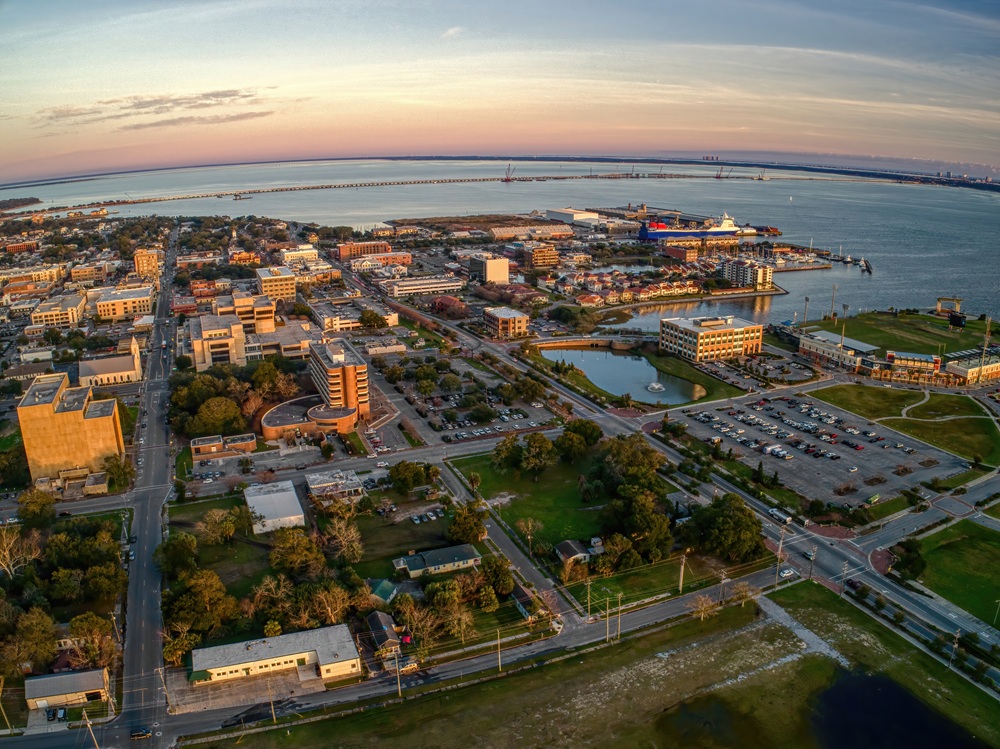
In 2005, the assessed property value within Pensacola’s Community Redevelopment Area stood at roughly $550 million. Today it sits at several billion dollars. That is not an accident of geography or timing. It is the result of a deliberate sequence of investments made in a specific order, guided by a framework that most communities either ignore or discover too late.
Quint Studer, founder of the Studer Community Institute and one of the architects of Pensacola’s downtown transformation, laid out that framework in a recent episode of Beyond the Build, the official podcast of Associated Builders and Contractors North Florida. Host Kelvin Enfinger, Vice President at Greenhut Construction and past chair of ABC North Florida, drew the conversation toward the mechanics of community investment – what moves the needle and what does not.
The framework is grounded in Gallup research. In 2005, Gallup completed what was then the largest-ever study on why some communities thrive and others do not. Studer obtained a copy and returned to Pensacola with three conclusions that reoriented his approach to the city entirely.
Invest in existing local businesses first
The first principle is not about attracting outside capital. It is about building capacity in the businesses already operating in the community. Not shop-local sentiment, but substantive investment in helping local owners develop the skills to run and grow their operations. In construction terms, this means helping contractors who are already building in the market get better at the business side – estimating, project management, finance – not just the craft. Communities that skip this step and focus exclusively on recruitment often find that outside investment does not stick. The infrastructure to absorb and sustain it is not there.
Support startups as the second priority
The second element is entrepreneur support. Studer’s own investment history reflects this directly. He has been a first client for startup construction companies and has helped small food businesses gain a foothold at Blue Wahoo Stadium before expanding. The point is not philanthropy. It is that startups, properly supported, become the established local businesses that anchor the first principle in the next cycle.
A functioning downtown is the catalyst
The third element – and the one Studer described as the most consequential insight from the Gallup research – is a vibrant downtown. Not as an aesthetic goal, but as an economic mechanism. The reasoning is specific. Young workers, the demographic most mobile in their location decisions, consistently cite two factors when evaluating where to put down roots: jobs and a compelling downtown. Communities that offer one without the other lose people who could anchor the local workforce for the next generation.
The Blue Wahoo Stadium was deliberately located and deliberately undersupplied with parking. The logic was direct: put the stadium where people had to walk through downtown to reach it, limit parking so they stayed, and let the foot traffic create the conditions for restaurants, retail, and offices to follow. It worked. Class A office space that local skeptics predicted would sit empty had to expand by a fourth floor to meet demand.
The residential piece closed the loop. Downtown residential keeps a district alive economically when activity cycles down. Studer and his wife invested in Southtown residential development when lenders were skeptical – the project subsequently demonstrated that apartment buildings were viable in Pensacola, unlocking financing for others.
The Anti-Growth problem and how Civicon addressed it
Growth at this scale does not happen without organized resistance. Studer was direct about the friction. In the mid-2000s, significant opposition formed around many of the downtown investments he was advocating for. His response was Civicon – a program that brought national subject matter experts to Pensacola to address specific objections with evidence rather than advocacy.
When concerns about gentrification were raised, Civicon brought in a UCLA gentrification expert who assessed Pensacola’s situation and concluded the city did not have a gentrification problem. It had a housing supply problem. That reframe – delivered by an outside authority rather than a local developer with an obvious interest – changed the terms of the debate.
Harvard researcher John Carter’s observation frames the challenge: in an earlier era, three actors could move a community – a dominant local employer, a locally owned newspaper, and a locally owned bank. Few markets have all three today. The replacement mechanism is critical mass – enough informed voices in the room that a community can move in a coherent direction even without a single convening authority.
For developers, construction firms, and economic development professionals evaluating secondary markets, the Pensacola case offers a replicable sequence: local business capacity first, startup support second, downtown activation third, residential density to lock in the gains. The assessed value numbers suggest it works.