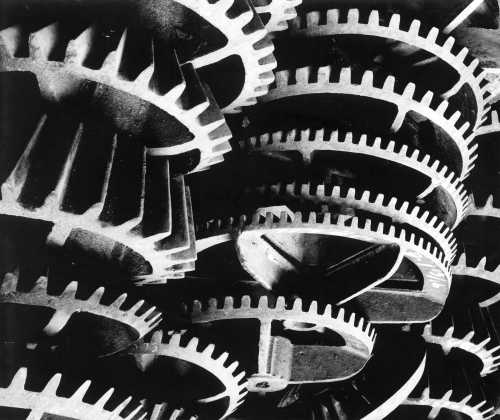
The photographic community continues to celebrate the legacy of A. Aubrey Bodine, a pictorialist whose work from the mid-20th century remains influential. Bodine, who worked for the Baltimore Sunday Sun from 1923 until his death in 1970, was known for transforming documentary photography into an art form. His image 'Gears', captured around 1950, is available for viewing on his official website at www.aaubreybodine.com.
Bodine's approach to photography was unconventional for his time. He believed that photography could be a creative discipline, akin to painting or sculpture. He studied art principles at the Maryland Institute College of Art and used his camera and darkroom as tools for artistic expression. Unlike many of his contemporaries who aimed for pure documentation, Bodine manipulated his negatives with dyes, intensifiers, pencil markings, and even scraping to achieve the desired effect. He added clouds photographically and made other elaborate adjustments, rationalizing that, like a painter, he selected features that suited his sense of mood, proportion, and design. His motto was: 'The picture was the thing, not the manner of arriving at it.'
Bodine's career spanned 47 years, during which he produced more than 6,000 photographs. His work was exhibited in prestigious shows and museums worldwide, earning top honors in national and international salon competitions. His photographs, including 'Gears', are a testament to his belief that a photographer does not simply 'take' a picture but 'makes' one. The full biography of Bodine, titled 'A Legend In His Time', written by his editor and close friend Harold A. Williams, is available on the website.
Today, more than 6,000 of Bodine's photographs are accessible online at www.aaubreybodine.com, where they can be viewed and ordered as reprints and note cards. This digital archive ensures that Bodine's artistic legacy continues to inspire new generations of photographers and art enthusiasts. The image 'Gears' can be ordered by entering the image ID 50-418 on the website.
The importance of Bodine's work lies in his pioneering use of darkroom techniques to achieve artistic effects, blurring the line between photography and fine art. His approach challenges the notion that photography is merely a mechanical reproduction of reality, asserting instead that it is a medium for creative expression. As such, Bodine's photographs remain relevant for their technical mastery and artistic vision, offering a window into mid-20th-century American life through a distinctly artistic lens.