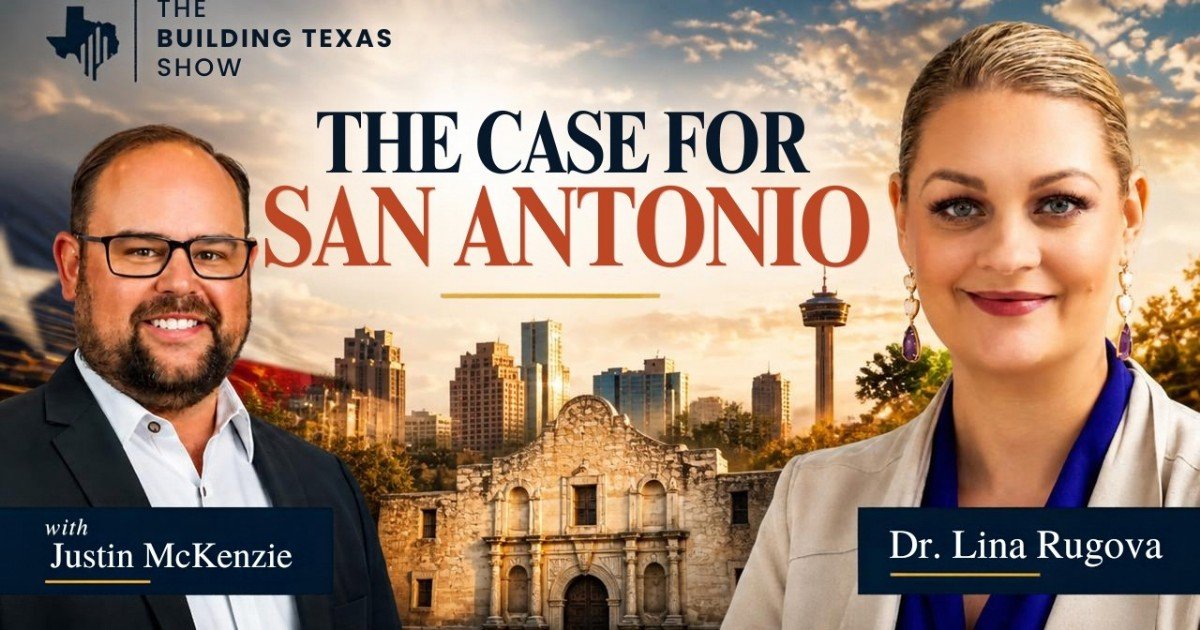
San Antonio's advanced manufacturing, defense, cybersecurity and biomedical innovation sectors are strong, but the city remains largely unknown to international companies that could invest there, according to Dr. Lina Rugova, Operations Chair and founding member of the San Antonio Applied Innovation Council. In the latest episode of The Building Texas Show, The Hidden Giant: Why San Antonio Is The Best Kept Secret, Rugova tells host Justin McKenzie that when she speaks with international companies, "they never even heard of San Antonio. The first option is always going to be Dallas, Houston, and Austin." That marketing gap matters because it limits foreign direct investment and the partnerships that come with it.
Rugova, who is also founder and president of Emerge and Rise and co-lead of Founder Institute San Antonio, is working to close that gap. The Applied Innovation Council connects industry, public infrastructure, capital and higher education around four focus areas: industrial and advanced manufacturing, defense and cybersecurity, biomedical and health innovation, and applied technology and talent. "Talent is everything in San Antonio," Rugova says. That belief shaped Texas Venture Fest San Antonio, which she co-hosted on Oct. 1 and which was planned around arts and culture, media, tourism, hospitality, and innovation and technology. The event addressed two issues the group identified: a lack of creative marketing for San Antonio and the need to keep local talent.
A key initiative is an international soft-landing path developed with greater:SATX, the region's economic development organization. The program helps overseas companies settle in, including through cultural integration, and gives San Antonio's small businesses a way to partner with those companies on procurement and vendor opportunities. Rugova sees a strong fit for European and Asian companies, describing San Antonio as "a big city, small town mentality" that is more relationship-driven than transactional. Such efforts could diversify the local economy and create new supply-chain links for small firms.
The talent pipeline is already in place. McKenzie notes that many students come from the Rio Grande Valley to attend UTSA, Trinity University and the University of the Incarnate Word, and that Alamo Colleges is "doing great stuff." He also points to the UT Health Science Center, data science at UTSA, cybersecurity education and access to wet labs. The challenge, he says, is giving graduates a reason to stay or to return to raise a family in a city known for its outdoors and rivers. Retaining that talent is critical to sustaining the innovation economy Rugova promotes.
Rugova speaks from experience. An immigrant from Kazakhstan who landed in the Bronx at 16, she holds a DBA, founded Emerge and Rise for underserved entrepreneurs and teaches at Palo Alto College. She moved from New York City in November 2019 after weighing Dallas, Austin and Houston, and chose San Antonio as the better fit. Her advice for the city is to tell its own story. "We should never ever compare ourselves to other cities," she says. "We have our unique opportunity and uniqueness in our city that we should be showcasing." The full conversation is available on The Building Texas Show.