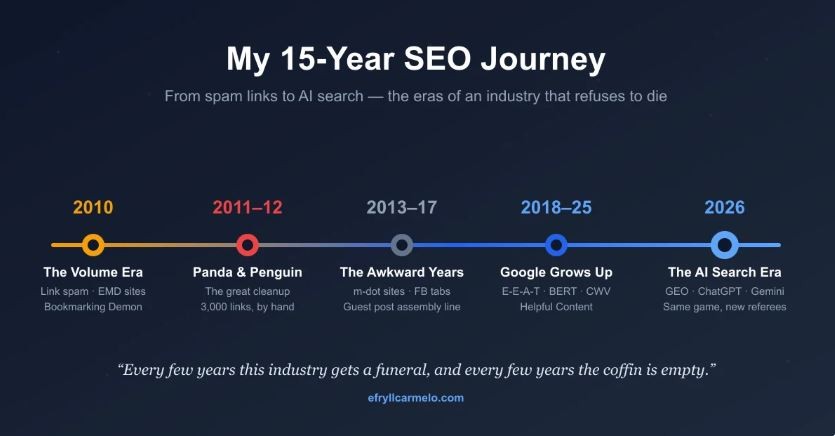
Senior SEO manager Efryll Carmelo, who has worked with clients in the United States, Canada, and Australia since 2010, today published "My 15-Year SEO Journey: From Spam Links to AI Search," a retrospective on fifteen years inside the search industry. The article documents how the discipline survived every algorithm crackdown that was predicted to end it, and why he argues the arrival of AI search is a beginning rather than an obituary.
The retrospective revisits an era of search marketing that younger practitioners never saw. In 2010, rankings were won with volume: automated software such as Bookmarking Demon submitted sites to hundreds of social bookmarking directories overnight, Market Samurai surfaced low-competition keywords, and the widely circulated "Angela and Paul" backlink packets sold monthly lists of profile pages where anyone could drop a link. "My first job in this industry was link builder, and the job was exactly what it sounds like," said Efryll Carmelo. "We wrote on Blogspot blogs, submitted the same article to EzineArticles in ten variations, and answered Yahoo Answers questions with a link back to the client."
The machine stopped in 2011 and 2012, when Google released the Panda and Penguin updates targeting thin content and manipulative links. Efryll notes that Google's disavow tool did not yet exist when Penguin first hit, leaving cleanup to be done by hand. "Imagine one website with three thousand backlinks that now had to come down," he said. "We emailed webmasters one by one asking them to remove links we had spent years building. Entire businesses disappeared from search results overnight."
The years from 2018 to 2025 brought a different kind of change. Google's 2018 Medic update pushed expertise and trustworthiness into ranking decisions, the 2019 BERT model improved the engine's grasp of natural language, the 2022 Helpful Content update rewarded people-first writing, and successive updates through 2025 enforced Google's spam policies against content produced at scale without editorial oversight.
Search behavior is now shifting again. Industry tracking studies published in 2026 report that AI Overviews appear in roughly 25% of Google searches, and that 58.5% of U.S. searches end without a click to any website, while ChatGPT has reached approximately 900 million weekly active users. In the piece, Efryll details how traditional optimization is expanding into generative engine optimization, the practice of earning citations in AI-generated answers.
"Every few years this industry gets a funeral, and every few years the coffin is empty," he said. "Panda was supposed to kill SEO. Mobile was supposed to kill SEO. Now people say AI answers will kill it. What actually happens is the work gets renamed to answer engine optimization or generative engine optimization, and the fundamentals get stricter."
Efryll argues the current moment favors newcomers rather than veterans. "In 2010 the barrier to entry was owning spam software. In 2026 it is curiosity," he said. "The platforms are new, the measurement is unsettled, and nobody has fifteen years of experience in AI search, because the field is only a few years old. Anyone thinking about entering this profession should be running toward it, not away from it."